Prusament Resin Model+
Prusament Resin Model+ is a high-quality resin developed with a strong emphasis on both user safety and print quality. It offers exceptionally short exposure times, sharp details, low shrinkage, and perfect platform adhesion coupled with high printing performance and reliability. Our unique formula also minimizes unpleasant odors and potential health risks. These qualities make the Model+ resin a perfect choice for a wide range of use cases from hobby printing, educational projects, art, design, high-end industrial prototyping, or dental models.
Characteristics
Pros
- Stiff mechanical properties
- Perfect platform adhesion
- Short exposure time
- High resolution
- Low shrinkage
- Low viscosity
- Low odor
- Low health hazard (cured parts are non-cytotoxic and non-skin irritant)
- Does not contain Bisphenol A, Acryloylmorpholine, and TPO
Cons
- Poor high-temperature resistance
- Yellowing of parts after prolonged post-curing (dissapears with elevated temperature and over time)
- The uncured resin might pose a health risk
- Non-recyclable material
Application

Perfect details for hobby models
Scale modelers, miniature painters, or tabletop gamers appreciate not only the sharp details, rate of printing, and ease of handling but also the low odor and health risks, making the resin more suitable for home and hobby use.
Excellent for rapid prototyping
The main advantage of the Prusament Resin Model+ is a rapid, high-resolution, and reliable printing process. Components printed with this resin offer stiff mechanical properties, low shrinkage, and aesthetic parts suited for industrial rapid prototyping.


High opacity and tiny details for dental models
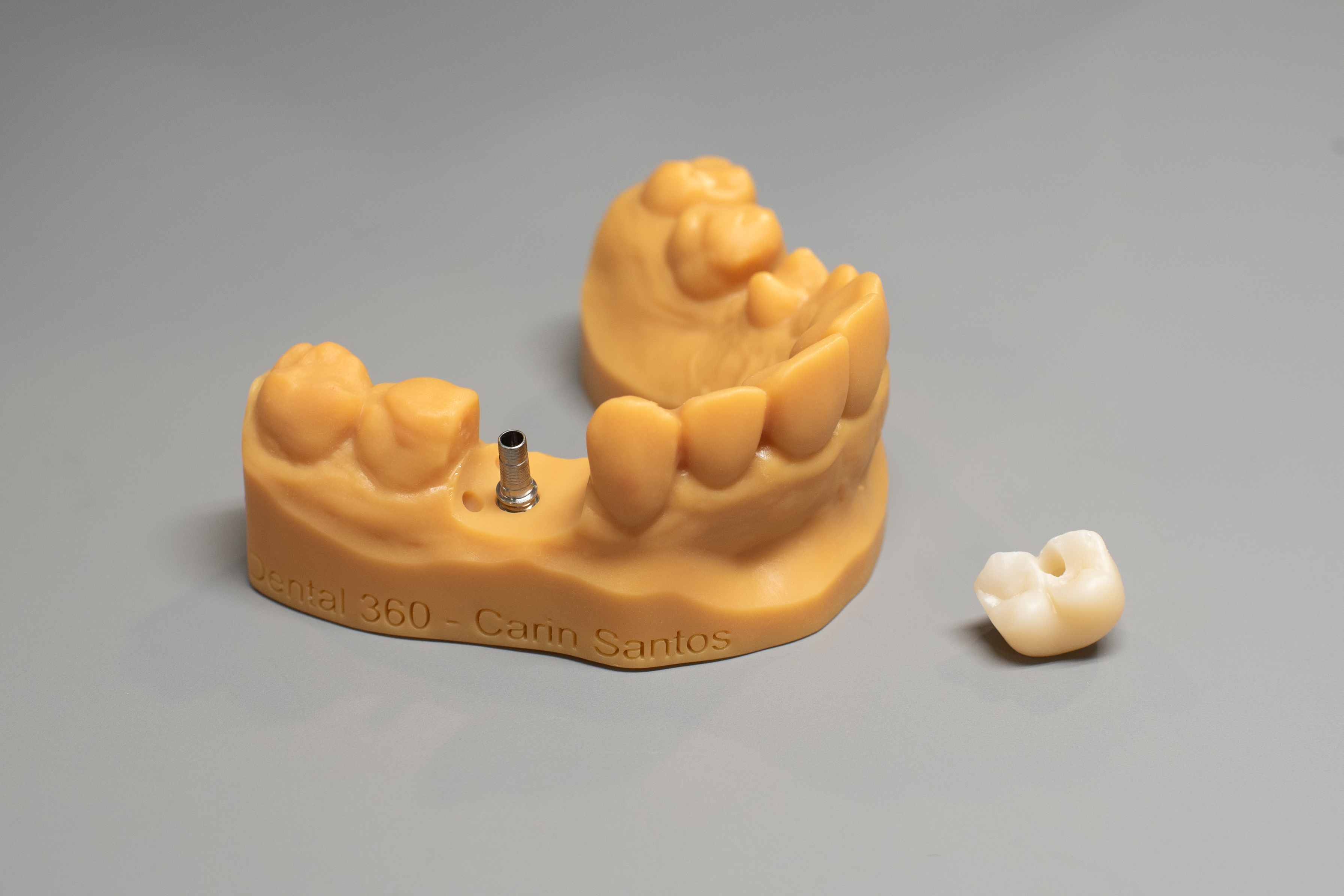
The visual and mechanical properties of the Model+ series were tuned to meet the requirements of dental and stomatology applications. Even the most intricate details are sharp and perfectly visible thanks to the resolution capabilities and opacity of the resin. Alabaster White, Solid Grey, and Neutral Beige resins are especially suited not only for dental model applications but also for thermoforming bracelets and heat-shaping orthodontic models.
Suitable for precise silicone molding
The Prusament Resin Model can be used for making various casting molds. You can either print a master model to make a mold from it or you can print the mold itself, for example for casting silicone. Standard post-processing procedure (washing and curing) is sufficient to obtain molds for silicone casting without inhibition effect on silicon curing.

Details
- Print difficulty
- Easy / Medium
- Toughness
- Average
- Odor
- Low
- Transparency
- Translucent in thin layers
- Post processing
- Easy
- Detail
- High
- 3D Printer Compatibility
- All 405 nm SLA 3D printers
- 0.05 mm Layer Exposition Time (SL1S)
- 2-2.4 s
- 2 mW/cm2 printer UV source output
- 1st Layer Exposition Time
- 7-8 s
- CW1S Curing Time
- 5 min or more
- Recommended Cleaner
- Prusament Resin Cleaner DPM or IPA
- Recommended Washing Time (DPM)
- 5 min
Prusament Resin Model+ is our reformulated SLA resin with faster exposure, better impact resistance, and reduced pigment sedimentation. We reworked the formula of Model resin to improve reactivity and mechanical resistance. The result is resin with consistent (in time and across resin batches) print properties, exposure times as fast as 2-2.6s per layer (0.05 mm, depending on the printer and color), improved impact resistance, and ductility. Prusament Resin Model+ moves one step closer to industrial resins while remaining as easy to print as hobby resins. Plus, the Model+ formulation significantly reduces sedimentation, making the work more comfortable. We still recommend mixing it, though, at least for a short time.
While the formulation has changed, the use cases remain pretty much the same. The easy printing, great resolution, broad color range, and low toxicity make it usable for everyday use: from rapid prototypes to hobby models. And as for the professional use, the Model+ resin can be used for dental applications, vacuum forming, silicone molding and other fields, where high precision and color consistency are a must.
Download Safety Data Sheet Alabaster White (PDF)
Download Safety Data Sheet Solid Grey (PDF)
Download Safety Data Sheet Neutral Beige (PDF)
Download Safety Data Sheet Rich Black (PDF)
Download Safety Data Sheet Transparent Clear (PDF)
Download Safety Data Sheet Prusa Orange (PDF)
Download Safety Data Sheet Prusa Pro Green (PDF)
Available colors


Beginners tips & tricks
Mix the resin thoroughly before every use
Shake the bottle / mix the resin in the vat thoroughly before printing. The pigment mixed in the resin formulation may sit on the bottom, and the print might fail.
Keep a proper ambient room temperature
The working temperatures can be found in the technical datasheet. The best temperature for printing Prusament Resin Model+ is somewhere between 25-30 °C. Low temperatures have a negative effect on the resin viscosity and may lead to print failure. If the room temperature is too low, you can use CW1S to preheat the resin before printing.
Use dense but thin supports for the best results
For most models, we recommend using a dense support-point mesh with a small head diameter. Removing nicely prepared dense support material should be easy and feel like Velcro. On the other hand, large, yet sparse supports are hard to remove and leave unsightly marks on the model surface.
Resin de-yellowing
When printing most SLA resins, you may notice a slight yellowing effect after curing your models. However, the yellowing is a mostly reversible process, and with just a little help, it can be easily minimized. All you need to do is wait long enough or warm the model for several hours. You can learn the whole de-yellowing process in our dedicated article.

Yellowing gradient with various post-curing times. The whitest model is an uncured model (green body), the yellowest was post-cured for 60 min at CW1S.
Featured Model+ prints